

The Cyprus affiliate of multinational accountancy firm Deloitte signed off on backdated paperwork for companies beneficially owned by Roman Abramovich, which helped the firms retroactively transfer billions of dollars in assets from Cyprus to the British Virgin Islands (BVI) to try to get around tightening tax and transparency laws, leaked files show.
By piecing together years of email correspondence and financial records, reporters found that in the mid-2000s Deloitte Cyprus discussed and helped to execute the transfer of assets — including bank deposits, yachts, and luxury real estate — in the wake of increased taxes and transparency requirements on foreign-owned and private firms in Cyprus ahead of its accession to the European Union in 2004.
Key Findings
- Leaked files containing years’ worth of email correspondence and financial records show how Deloitte Cyprus worked with other firms managing Abramovich’s wealth to move vast assets from Cyprus to the British Virgin Islands (BVI), including cash deposits in banks, superyachts, and luxury homes.
- The files come from inside MeritServus, a now-U.K.-sanctioned Cypriot corporate services provider which worked closely with Deloitte Cyprus on backdated paper trails to make it appear that assets had moved to the BVI years earlier.
- Backdated paperwork generated in the mid-2000s allowed one Cyprus company to remove assets from declarations submitted to Cypriot authorities years later. Leaked emails indicate the paper trails were created to avoid legislation in Cyprus which required more tax and transparency from foreign-owned and private firms.
- There is no evidence Abramovich was aware of or approved the preparation of the paperwork, and lawyers for Abramovich denied that he had “evaded or sought to evade tax,” saying it was “entirely proper” for his companies to follow advice from Deloitte Cyprus. Deloitte Cyprus said it “acts in compliance with applicable laws” but declined to comment further.
Deloitte Cyprus worked closely on the plans with MeritServus, a now-U.K.-sanctioned Cypriot corporate services provider that was a division of Deloitte Cyprus before it was spun out as an independent firm in 2005.
The two firms advised senior staff at Millhouse Capital U.K. Limited, a firm managing assets owned by Abramovich, and Millhouse LLC in Russia.
Some of the email exchanges between the firms discuss drawing up paperwork in 2005 that would enable a Cyprus company beneficially owned by Abramovich to declare to Cypriot authorities that almost $2 billion in bank deposits it had received from the sale of shares in Russian oil company Sibneft in 2003 had been held on behalf of a BVI firm, which would mean the money was not subject to so much tax in Cyprus. The Cyprus company’s 2005 financial report, obtained by reporters, indicates the plan was implemented: the report says the company held $870 million in trust for its BVI parent in 2004 – the year before the backdated paperwork was prepared.
In another case, in 2006, Deloitte Cyprus staff certified 2003 financial statements for a Cyprus-registered company beneficially owned by Abramovich to make it appear the firm had offloaded assets worth nearly $700 million. The paperwork stated the assets had been held by the Cypriot firm’s parent company, which was located in the BVI, since 2003. In fact, the assets were held by the Cypriot company from 2003 to 2006.
There is no evidence Abramovich “participated in, authorised or knew of” the plans to prepare, backdate, or falsify records, a law firm representing Abramovich said in response to OCCRP. The law firm said their client’s companies “engaged professional firms, including Deloitte, … to establish, administer, and audit them. Those firms were relied on…to do so properly and in accordance with all applicable legal requirements.” They denied that Abramovich had “evaded or sought to evade tax” or “unlawfully or improperly concealed his assets.”
Deloitte Cyprus said it “acts in compliance with applicable laws” but declined to comment further, saying it could no longer access correspondence from 20 years ago. There was no reply to questions sent to Deloitte Global’s head of communications.
The findings come as Abramovich remains under investigation by authorities in Jersey in connection with suspected money laundering relating to the proceeds of the sale of Sibneft. (Lawyers for Abramovich said he “denies all of the allegations” and that no charges have been brought.)
Demetris Ioannides, MeritServus’ chairman and managing partner from January 2005, was sanctioned by the U.K. government in 2023 for creating “murky offshore structures” which it alleged Abramovich “used to hide” assets worth almost $1 billion. One of the MeritServus companies, MeritServus HC Limited, was sanctioned by the U.K. at the same time.
Through his lawyers, 83-year-old Ioannides, who was also chairman of Deloitte Cyprus for nearly two decades until 2005, declined to comment, citing ill health.
Alex Cobham, an economist and chief executive of the U.K.-based Tax Justice Network, said he believed that the “deliberate creation of false documentary evidence to support a position that you know isn’t true, and present it to the tax authority” could amount to tax evasion.
Deloitte and its offices around the world “are supposed to be the ones upon whom investors and also authorities can rely that the numbers are basically straight,” Cobham added.
After reviewing a summary of the leaked evidence, Andrew Mitchell KC, a barrister at the legal practice 33 Chambers, described the backdating efforts of Deloitte Cyprus, MeritServus, and Millhouse as “a straightforward and blatant move to protect from legitimate taxation assets which should otherwise have been subject to tax.”
About the Investigation
Cyprus Confidential, an ongoing global investigative collaboration, is based on more than 3.6 million documents leaked from six different Cypriot service providers including MeritServus.
The MeritServus records were shared with OCCRP, the International Consortium of Investigative Journalists, Paper Trail Media, and other media outlets by Distributed Denial of Secrets (DDoS). OCCRP has previously reported on MeritServus, and the current project builds upon this work.
This investigation is led by the Bureau of Investigative Journalism and carried out in partnership with the Guardian, BBC, and CIReN.
Rewriting History
The leaked emails show how senior figures at Millhouse, MeritServus, and Deloitte Cyprus spent months corresponding about a tax bill that was looming for Cyprus-registered firm Kravin Investments Limited.
Kravin was set up for Abramovich in 1999. It was among a stable of Cyprus-based companies, trusts, and bank accounts which MeritServus, still a division of Deloitte Cyprus at the time, set up and administered to service Abramovich’s booming international business operations during the early 2000s.
By 2005, Kravin and dozens of other companies were all owned by a single Cyprus trust called Sara Trust. Abramovich was the trust’s beneficiary and MeritServus’s Ioannides was a trustee.
Kravin had received a windfall of $3 billion in 2003 after Abramovich sold 20 percent of Russian oil giant Sibneft to another Russian oil company called Yukos. Just over one month after the Yukos funds started coming through, on the day Abramovich acquired Chelsea Football Club, Kravin’s shareholder issued a substantial loan facility to the team’s parent company.

(Abramovich had acquired Sibneft from the Russian state in the mid-1990s for $248 million after gaining control of the company through an auction in which Abramovich’s company’s bid faced “no genuine competition,” according to an English High Court judge. He would go on to sell his remaining stake in Sibneft in September 2005 to Russia’s state-owned energy conglomerate Gazprom for $13 billion. Abramovich’s lawyers said the High Court judgment “made no finding that any auction was corrupt or unlawful” and denied Abramovich was “party to unlawful transactions in Sibneft shares.”)
In mid-2005, Deloitte Cyprus, Millhouse, and MeritServus started discussing how funds sent by Yukos to Kravin after the Sibneft share sale had accumulated millions of dollars in interest. Draft financial statements for 2003 show these funds amounted to around $1.8 billion on December 31, 2003.
The email exchanges state that interest earned on Kravin’s bank deposits was subject to Cypriot corporation tax and a newer additional levy which required foreign-owned Cyprus companies to pay tax on interest earned on their passive income. That legislation had come in just before the 2003 Sibneft payout.
An email exchange showing the agenda for a meeting in Moscow in June 2005 shows that Deloitte Cyprus, MeritServus, and Millhouse were due to discuss “tax risks and the options available to eliminate them in past periods,” as well as “disclosures for the Sibneft/Yukos deal.”
Then, in August 2005, Deloitte Cyprus’s partner Antonis Taliotis sent an email to MeritServus’ Ioannides saying that the interest on Kravin’s income for the first six months of 2005 alone was $10 million. That interest “will suffer a 15% effective taxation” Ioannides said, urging a discussion.
By then, MeritServus’s Ioannides and Natalia Khudyk from Millhouse were discussing an idea first floated by Ioannides in 2003 which he had said at the time would “avoid the payment of tax.” According to Ioannides’s suggestion, the funds held by Kravin should be paid out as an interim dividend to its holding company in the BVI, where it would not be subject to tax. Kravin would then agree to invest the dividend on behalf of the holding company.
In the leaked correspondence from 2005, Ioannides detailed the need to create a series of documents that would make it look as though Kravin had paid the Sibneft proceeds as a dividend in May 2003 to its shareholder Kelvedon Worldwide Limited, another company beneficially owned by Abramovich and managed by MeritServus. The paper trail would indicate that Kravin then held onto the funds on Kelvedon’s behalf.
Abramovich’s lawyers said he denied evading taxes. “If an arrangement was proposed by professional advisers of Deloitte’s standing, it would have been entirely proper for companies linked to [Abramovich]…to rely on it,” they said.
In an email to Khudyk in August 2005, Ioannides said the idea had already been agreed with Taliotis and another Deloitte Cyprus partner, Nicos Charalambous.
“If you agree, it will be necessary to change the financial statements and the accounting records accordingly for 2003 and 2004,” Ioannides wrote to Khudyk.
The following month, Ioannides wrote to Khudyk again, this time attaching drafts of letters he said needed to be exchanged between Kelvedon, MeritServus, and Kravin, some backdated to 2003. The letters set out the general terms for a dividend payment to Kelvedon that year and the management of the funds by Kravin ever since.
Reporters were not able to independently confirm the arrangement was implemented. Cyprus’s business register said no financial statements for Kravin were filed in 2003 or 2004.
However, the leaked correspondence shows MeritServus went on to compile reports for 2004 and 2005 in which Kravin appeared to report to Kelvedon on how its investment funds had been doing.
In addition, in financial statements Kravin filed to Cyprus’s company register for 2005 the company declared just $15,000 in total tax contributions for 2004 and 2005.
Those financial statements, which records show were not filed until more than a decade later, in 2016, were officially approved by Nicos Charalambous, one of the Deloitte Cyprus partners. He was one of the people who discussed and agreed on the backdating strategy, according to leaked emails. Charalambous signed a report confirming that the statements “give a true and fair view of the financial position of the company.”
There was no reply to messages and calls to a phone number for Charalambous, who has left Deloitte according to his LinkedIn account.
Antonis Taliotis, who remained a partner with Deloitte Cyprus until leaving the firm earlier this year, told OCCRP he would reply via Deloitte, but the accounting firm declined to provide any comments.
There was no reply to questions for Khudyk sent via Millhouse in Russia, or to questions sent to one of Khudyk’s social media accounts.
MeritServus Under Scrutiny
One of MeritServus’ legal entities, Meritservus Secretaries Limited, and two former MeritServus staff members are defendants in an ongoing criminal tax case in Cyprus alongside BOYM – Blue Ocean Management Limited, a superyacht management company once beneficially owned by Abramovich.
The charges were brought following revelations by OCCRP, the Bureau of Investigative Journalism, and media partners last year that during the 2000s Blue Ocean set up a fake superyacht-chartering business in an apparent attempt to evade tax. MeritServus administered Blue Ocean, OCCRP found. The director of Meritservus Secretaries Limited previously declined to comment.
The superyacht firm is accused of failing to pay more than 26 million euros in taxes and accrued interest in the criminal case. Lawyers for Abramovich denied any allegation that he had any role in “any alleged deception of any government authority in order to evade payment of taxes which were lawfully due or for any other purpose.”
The defendants face charges including failure to pay tax and failure to pay penalties for late submission of tax returns. Blue Ocean is also charged with failure to submit tax returns.
The Institute of Certified Public Accountants of Cyprus terminated Meritservus’ licenses following U.K. sanctions in 2023, and emails sent by reporters to MeritServus email addresses bounced back.
Hidden Luxury Assets
The MeritServus files also indicate that Deloitte Cyprus, MeritServus, and staff at Millhouse agreed to create paperwork that would allow another company beneficially owned by Abramovich to leave hundreds of millions of dollars of his personal assets undeclared in financial filings to Cyprus authorities.
Draft financial statements for 2003 for a Cyprus company called Amiscan Investments Limited that are in the leaked files show a range of high-end assets were held by the company: several yachts worth a combined $354 million, several aircraft worth $142 million, and four properties in France and the U.K. valued at $127 million.
The draft financial statements were prepared by Deloitte Cyprus in July 2005, but in October 2005, an email from MeritServus’ Ioannides expressed second thoughts about declaring the assets.
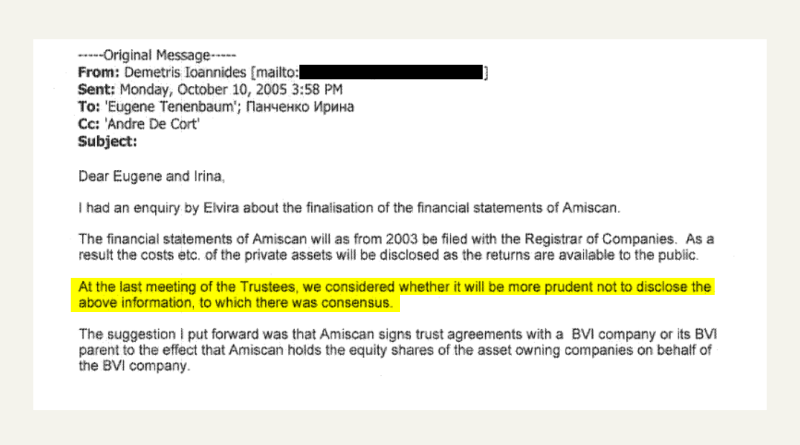
“The financial statements of Amiscan will as from 2003 be filed with the Registrar of Companies … private assets will be disclosed as the returns are available to the public,” he wrote in an email to Eugene Tenenbaum, then-director of the U.K.-based firm Millhouse Capital U.K. Limited, Irina Panchenko, then a financial adviser to Abramovich, and Andre de Cort, an in-house lawyer for Millhouse. “At the last meeting of the Trustees, we considered whether it will be more prudent not to disclose the above information, to which there was consensus.”
Ioannides was referring to a change in the law introduced in 2003 which meant foreign-owned private companies were required to publish detailed financial statements, which they had not had to do in the past.
Deloitte Cyprus, MeritServus, and staff at Millhouse undertook to create a paper trail that would make it look as though Amiscan had in early 2003 offloaded its subsidiary companies which held Ambramovich’s superyachts, properties, and other luxury assets.
(Through lawyers, Tenenbaum denied “unlawfully or improperly help[ing] Mr Abramovich conceal his assets,” saying he did not “participate in, authorise or know of any improper backdating of documents,” and that he “cannot recall the context to and detail of these purported matters, most of which are said to have taken place over 20 years ago.” De Cort declined to comment. There was no reply to questions for Panchenko sent via Millhouse in Russia.)
The paper trail would indicate that those subsidiary firms were now held by Kelvedon in the BVI. That firm was unaffected by the Cyprus legislation and would not be required to disclose assets there.
“We all agreed to transfer beneficial ownership of the shares of the owning companies to Kelvedon Worldwide Ltd,” Ioannides wrote in one February 2006 email. “Deloitte require to see the agreements/instruments of transfer so as to complete the audit of Amiscan.”
By November 2006, Millhouse drafted a sale and purchase agreement after discussing it with lawyer de Cort, emails show. The date on the agreement was put as January 4, 2003, for the transfer of 19 subsidiaries owned by Amiscan to Kelvedon.
Andreas Ioannou, Deloitte Cyprus’s then-audit manager, wrote in a November 2006 email to a Millhouse employee that the agreement would be “adequate for the purpose of supporting the removal of the subsidiary companies from the books of Amiscan.”
The following month, Deloitte Cyprus audited and signed off on Amiscan’s 2003 financial statements. This time, the value of assets was listed as zero.
An explanatory note read: “In January 2003 the Company has transferred at cost all of its investments in its subsidiary companies to its parent company. The subsidiaries were incorporated in Cyprus, the BVI, Isle of Man and A.V.V. Aruba, and were mainly involved with real estate and ownership of other tangible assets.”
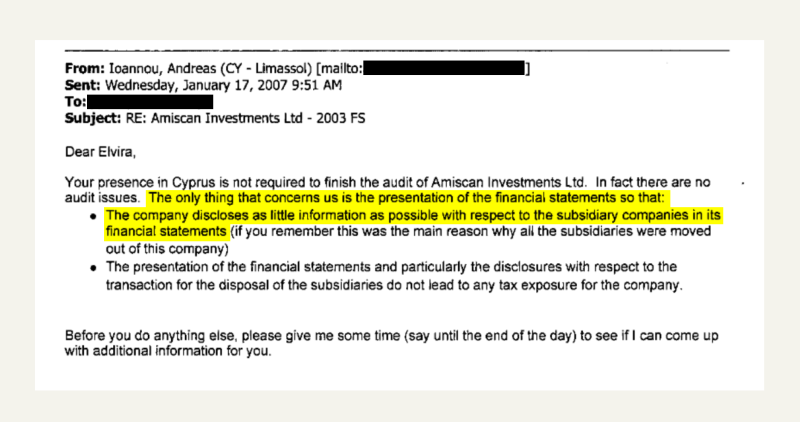
In an email sent in January 2007 to Millhouse, Deloitte Cyprus’s Ioannou wrote that the accountancy firm’s main priority was that Amiscan “discloses as little information as possible with respect to the subsidiary companies in its financial statements.”
A tax return for Amiscan certified by Deloitte Cyprus which was filed in Cyprus in 2007 covering the years 2003 and 2004 listed the value of the company’s investments at less than 400 Cypriot pounds (less than $700) in each of those years.
Prem Sikka, Emeritus Professor of Accounting at the University of Essex and University of Sheffield, reviewed the files and said: “Companies are required to publish true and fair accounts. And if the transaction dates are being misrepresented that is not being truthful.”
Rachel Sexton, an independent member of the U.K.’s Government Legal Department’s Audit & Risk Assurance Committee and independent non-executive director at Turicum Private Bank, said that there are legitimate reasons why a company would backdate documents: “For example, if the transfer of ownership happened in practice, but the paperwork was never formally signed, the company could produce a document that memorialises the past event.”
But, she said, this does not appear to be the case with Abramovich’s companies.
“Supporting documentation should not have been backdated if the structures and arrangements were not in place and the related decisions did not occur on those dates. Doing so could be considered to be fraudulent misrepresentation … Documents should state the date on which they were effective and signed on the date they are produced rather than executing them in a way to look like they existed earlier than they did. This could mislead anyone examining the corporate records.”
Andreas Ioannou, who still works at Deloitte Cyprus, did not respond to a request for comment.
The Doppleganger Firm
At the same time as the conversations about Amiscan were taking place, MeritServus, Millhouse, and Deloitte Cyprus were exchanging emails about another Cyprus-registered firm which indirectly held billions of dollars in assets for Abramovich.
Electus Investments Limited sat at the top of a vast ownership tree. Created in Cyprus in May 2001, it acted as the “ultimate holding company” for all assets beneficially owned by Abramovich’s Sara Trust, according to a 2002 letter from Deloitte Cyprus to Cyprus’ central bank.
That meant it indirectly owned dozens of companies that held assets worth billions of dollars.
Emails exchanged in 2006 show MeritServus, Millhouse, and Deloitte Cyprus discussing the fact that Sara’s trustees had decided they did not want to produce detailed financial statements for Electus.
But Millhouse’s Khudyk observed that because there was no company above Electus, the companies it owned could not be shuffled up to a “parent,” unlike in the case of Amiscan.
MeritServus’ Ioannides appeared to have the solution.
He laid out a proposal to Millhouse to retroactively transfer assets belonging to Electus to an identically named BVI firm, which he had set up in late 2003 and which would not be affected by the new transparency requirements in Cyprus.
This would involve backdated paperwork, the emails indicate.
“Electus Cyprus is now the beneficial owner,” Ioannides wrote in an email to Khudyk and other senior Millhouse staff in April 2006. “Therefore, we need in November 2003 to transfer the beneficial ownership of the BVI Holding Companies to Electus BVI.”
Electus’s financial statements covering 2003, which were filed to the Cypriot company register, indicate that the asset transfer happened.
Those statements, which were certified by Deloitte Cyprus and filed with the Cypriot company registrar some 14 years later, show that the billions of dollars of assets which would otherwise have appeared in its financial statements were not listed there.
One solitary investment — a shareholding in the U.K. branch of Millhouse valued at around $145,000 — did remain listed on Electus’s 2003 balance sheet. Leaked emails reveal that this particular detail of Electus’s financial history simply could not be rewritten.
Millhouse’s Khudyk initially proposed that they might as well liquidate the Cyprus entity but discovered that audited and published financial statements for its U.K.-registered subsidiary, Millhouse Capital UK Limited, had already identified Cyprus-based Electus as its “immediate and ultimate parent company” in 2003 and 2004, leaving a permanent, public record proving that the U.K. firm was owned by a Cyprus company, rather than a BVI one.
The reference to the Cypriot Electus in U.K. company records would make it difficult to retroactively claim that Millhouse’s U.K. branch had been owned by BVI-based Electus all along, Khudyk suggested.
In one email, Ioannides suggested that they could simply pretend that the U.K. company record describing Electus as Cypriot was merely a mistake – or else hope that no-one ever noticed the discrepancy.
But an email from Ioannides later that year shows that they decided to leave the U.K. subsidiary officially under the Cyprus Electus. “It was agreed to continue to do so as it has already been disclosed that [Electus Cyprus] is the parent,” he wrote in October 2006.