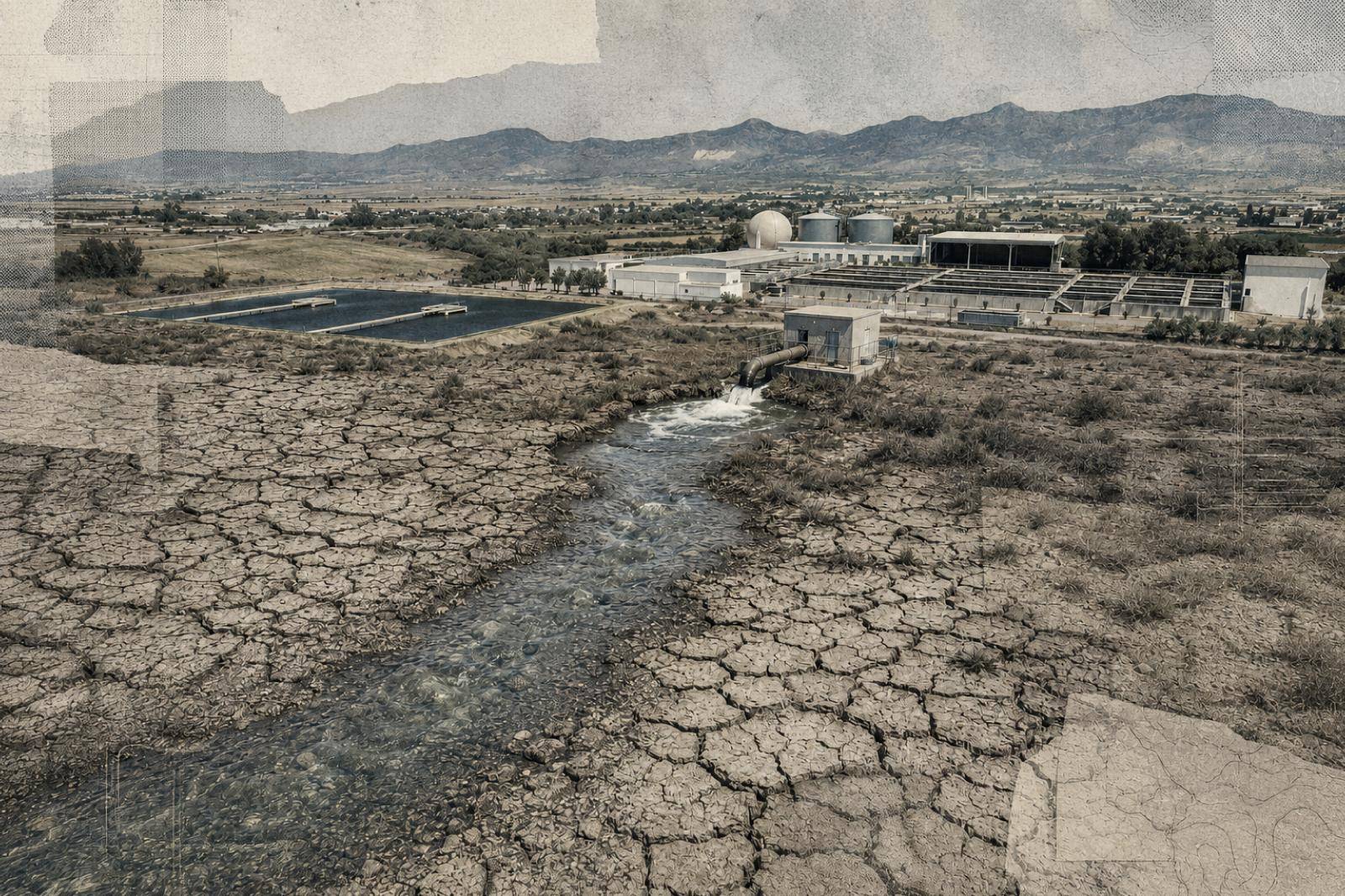
Every day, 30,000 cubic metres of treated water is released from a wastewater plant close to the United Nations-patrolled buffer zone in the divided capital city of Nicosia. The plant sits at the heart of Mesaoria, Cyprus’ largest plain, where agriculture is increasingly water-starved and decades of groundwater extraction have depleted many wells.
To this day, most of the water from the treatment plant has been discharged directly into a river, recharging some groundwater along the way but never reaching the farmlands it was meant to serve. An infrastructure project, decades in the making but on the down low, is about to change that by piping some of the treated water across the island’s division, from the Turkish Cypriot northern part of Cyprus, where the plant is located, to the Greek Cypriot south. This modest pipeline may quietly become one of the more consequential pieces of infrastructure on the island.
A Flagship Nobody Talks About
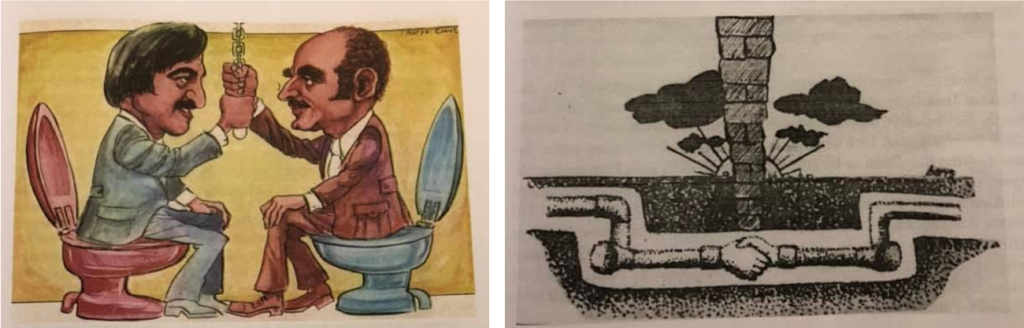
At the heart of Nicosia lies a success story informally dubbed “sewage diplomacy” – a joint sewerage system that has forced the two halves of the world’s last divided capital to keep interacting with each other for five decades.
The Mia Milia/Haspolat wastewater treatment plant, officially the Nicosia Wastewater Treatment Plant, located in an industrialised suburb in the northern part of Cyprus, is probably the longest-running example of Greek Cypriot–Turkish Cypriot cooperation on the island since the division in 1974.
The flagship project has been running uninterrupted since the era of Lellos Demetriades and Mustafa Akıncı in the late 1970s, through to the mayors who run Nicosia today. The plant never stopped functioning, not even during the years when there were no crossings between the two sides of the divide.
Its continued operation was driven by necessity, which created an incentive to cooperate. Sewage flows downhill, and topography does not recognise political dividing lines. Rerouting the network to avoid the flow across the divide would cost more than anyone has ever been willing to spend. So through the leadership of successive mayors, the plant kept running jointly with wastewater from the southern part of the island flowing into it.
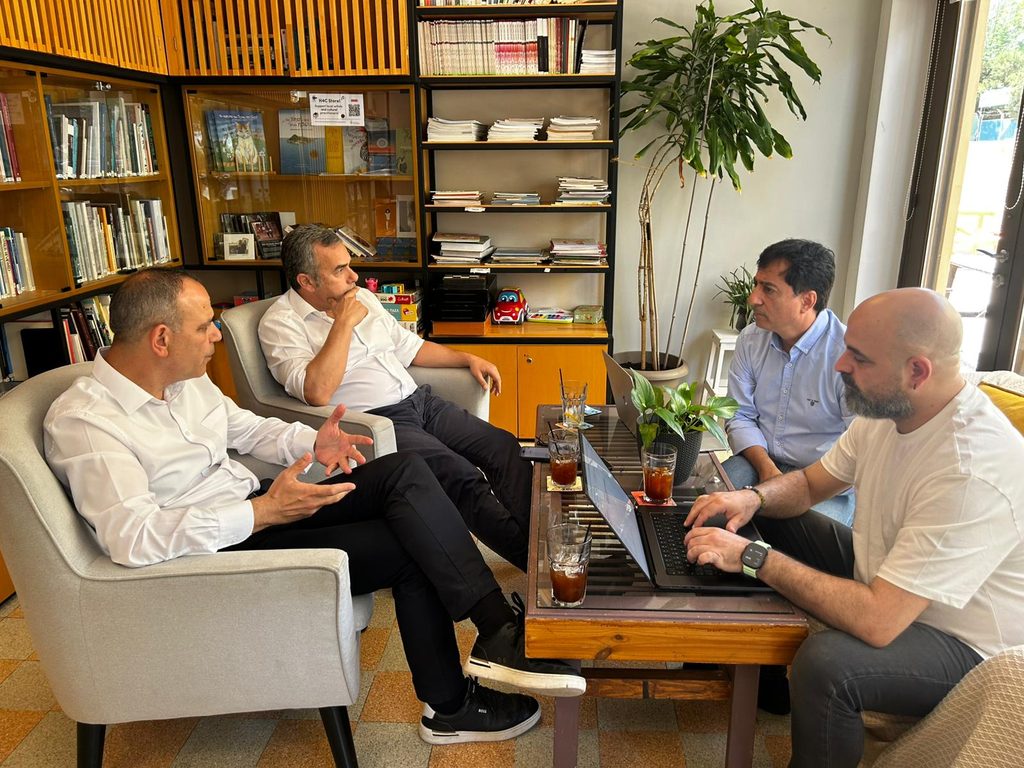
“When you have good cooperation you can sit down and exchange ideas and brainstorm and never lose hope,” says Constantinos Yiorkadjis, former mayor of Nicosia and the current President of the Nicosia District Local Government Organisation (EOA), which is responsible for every sewerage system in the Nicosia district. His Turkish Cypriot counterpart, Mehmet Harmancı, mayor of the Nicosia Turkish Municipality for the last three terms, puts it more plainly: “Whether we like each other or not, it’s a necessity.”
And now, an EU-funded pipeline, built quietly alongside a repair project, is about to carry treated water from the plant across the divide on an island that needs every drop as it struggles with the impacts of climate change and drought.
Origins: One Sewerage System for The City (1971–1974)
Nicosia’s first modern sewerage system predates the island’s division: in March 1971, the World Bank approved a loan for the Nicosia Sewerage Project. The system’s treatment works were situated at Mia Milia/Haspolat, which was a Greek Cypriot village with 1,381 recorded inhabitants in 1973. It was a choice dictated by gravity and geography, since, as Harmancı puts it, “the topography was taking all the dirty water to that area.”
The original plant, tendered in the early 1970s under the United Nations Development Programme (UNDP) umbrella, was a basic wastewater treatment system known as a lagoon, with a capacity of 10,000 cubic metres per day.
By mid-1974, the project was roughly complete with about 86 km of sanitary sewers and 26 km of house connections laid, when a Greek-backed coup followed by a Turkish invasion in July 1974 halted everything. The ceasefire line that ran across Nicosia, dividing the city, froze into the buffer zone, also known as the Green Line. The treatment plant was left in the Turkish Cypriot north, while most of the sewerage network and the Sewerage Board of Nicosia remained on the Greek Cypriot south.
Sewage Diplomacy: The Demetriades–Akıncı Understanding (1977–1980)
Geography created a mutual dependence: the south had the sewers but no plant; the north had the plant but lacked the rest of the system. Building separate systems for each half of the city was found to be prohibitively costly at a time when, in Harmancı’s words, “the economy was suffering.” In September 1978, Nicosia’s Greek Cypriot mayor, Lellos Demetriades, and Turkish Cypriot mayor Mustafa Akıncı reached a pragmatic understanding: the work on the sewerage infrastructure and the treatment plant at Mia Milia/Haspolat, in the Turkish Cypriot part of the city would be completed, and the single system would be operated jointly, with sewage from both sides flowing to the one plant. The plant went into operation in 1980.
The significance went far beyond sanitation. The sewerage talks built the trust that led the same two mayors, both outspoken advocates of peace and reunification, to launch the bi-communal Nicosia Master Plan from 1979 onwards. That joint urban-planning framework later won the World Habitat Award (1989), the Europa Nostra Medal of Honour (2003) and the Aga Khan Award for Architecture (2007).
Three Decades of Quiet Operation and Slow Decline
For more than 20 years after 1980, the plant treated wastewater from both sides of central Nicosia. However, Nicosia’s population grew significantly, overloading a facility designed in the 1970s. By the early 2000s, the plant was causing serious odour and environmental problems. In 2003, the two sides took the decision to modernise the plant. The timing was not incidental: that April, the first crossing point on the Green Line opened in Nicosia, allowing Turkish Cypriots and Greek Cypriots to travel across the divide for the first time in nearly three decades. It was also a time when reunification talks between the two sides advanced and there was a prospect for Cyprus to join the European Union as a reunited country.
The plant’s first major modernisation included an upgrade of the treatment process that produced water suitable for agricultural irrigation. What it has produced since then, at a steady 30,000 cubic metres a day, is water clean enough to irrigate crops and recharge the aquifers that both communities depend on.

Building the New Nicosia Wastewater Treatment Plant
An agreement between the two communities was concluded in 2006, two years after negotiations to reunite the island had failed: Greek Cypriots rejected a United Nations-backed plan in simultaneous referendums in April 2004, while Turkish Cypriots approved it. Two yes votes were needed, and so Cyprus entered the EU a week later as a divided island.
The technical cooperation on the treatment plant carried on regardless. UNDP, as the neutral contracting authority, published an international tender in June 2009. A German firm, WTE Wassertechnik GmbH, which won the contract to build, and then to operate and maintain the plant for 10 years, started construction in March 2010. The new plant entered trial operation in 2013. UNDP announced full operation in April 2014, and the formal inauguration took place on 2 July 2014. The United Nations, which maintains a long-running peacekeeping mission in Cyprus, hailed the project as a “perfect example of bicommunal cooperation.”
Technically, the plant treats about 30,000 cubic metres of wastewater a day, serving central Nicosia neighbourhoods in both the north and south. The plant’s output meets EU standards for agricultural reuse. Harmancı says that “the treatment lagoons themselves are turning into a haven for birds”.
Operation and maintenance remain a shared undertaking, carried out by the German firm and overseen jointly by the Greek Cypriots and Turkish Cypriots.
The two sides informally agreed to share the plant’s recycled water for agricultural use: with 70% flowing to the south and 30% remaining in the north.
The 70-30% sharing formula itself mirrors the population, the contribution of each side to the plant’s financing and the amount of sewage flowing into the plant.
The Missing Pipe: Water That Ran Into The River
For more than a decade, however, that final part of the project – taking the treated water to the south and distributing it in the north – remained dormant and virtually the entire annual output – roughly 11 million cubic metres – was discharged into the Pedieos River/Kanlıdere. The benefits have been incidental rather than planned: the discharge replenishes groundwater along the water-stressed Mesaoria plain, where decades of drilling have taken their toll on what lies beneath, before reaching the sea.
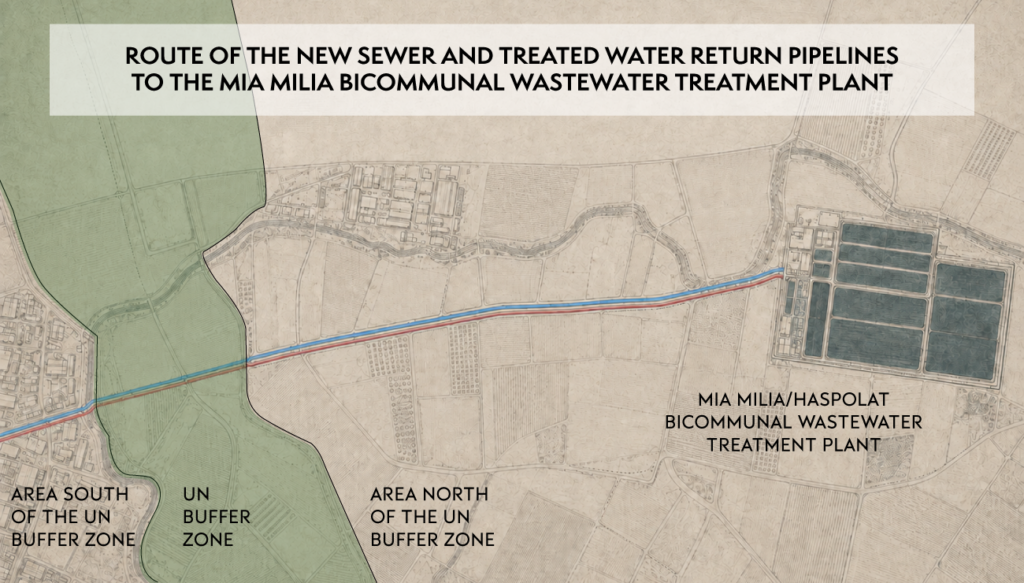
For years, the obstacle to transferring treated water was never treatment capacity: it was a hole in the ground. Trunk-1, the sewage trunk running from the south through the buffer zone, and into the plant, had begun to collapse. The ground kept caving in and the pipes disintegrating, forcing intermittent and increasingly urgent repairs. Its replacement became unavoidable.
The renewal of Trunk-1 created an opportunity. Running alongside the new sewage trunk, a second, EU-funded pipeline is now being built to carry part of the treated water to the south, back into the areas that need it. In a written response to CIReN, UNDP confirmed that EU funding has been secured for 2,713 metres of pipe running from the treatment plant to the end of the buffer zone. Works have been carried out on 2,003 metres, and the remaining 710 metres are expected to be completed by the end of November. A fuarther stretch of roughly 0.4 km will carry the pipeline further south from the buffer zone together with a pumping station at an EU-funded cost of roughly €2.5 million.
The pumping station, to be built close to the plant, will take part of the treated effluent to both communities for irrigation.
UNDP describes all of this as the first phase of a larger project aimed at reusing the majority of the treated effluent. The following phases, for which funding has not yet been secured, would lay additional pipes of larger diameters and build new water storage facilities in other areas for irrigation. For now, only the pipeline that will bring treated water to the south has been defined in detail. Design parameters for the other segments are expected to be drawn up later this year, and depending on funding, UNDP says the entire infrastructure could be completed by the end of 2029.
Back on the Table — And an Unwritten Understanding (2025–2026)
The political climate will hopefully catch up with the engineering. At the trilateral meeting between President Nikos Christodoulides, new Turkish Cypriot leader Tufan Erhürman and UN envoy María Ángela Holguín in December 2025, the two leaders agreed to prioritise confidence-building measures including the water pipelines from the Mia Milia/Haspolat plant.
While the two leaders had previously committed to implementing a series of confidence-building measures, progress on many has been slow at best, due to practical and bureaucratic obstacles. However, despite some delays, the recycled-water return project at Mia Milia/Haspolat has continued to move forward.
Neither Yiorkadjis nor Harmancı frames the water project as a message or example to the Greek Cypriot and Turkish Cypriot leaderships. “The whole purpose was not to send any message to anybody,” Yiorkadjis says. It was “just to get the city to work better.” But both describe a deliberate philosophy. In Yiorkadjis’ words: “If you have trust which is built on a historical context of actual results, then you can proceed step by step and try to tackle more complicated projects.”
On an island where people in the south drink desalinated water from the sea and people in the north drink water piped from a river in Turkey, what Mia Milia/Haspolat offers is proof, tested over 50 years, that a shared resource can be managed jointly across the island’s hardest line, without waiting for the political problem to be resolved first. The pipeline currently under construction is not a new experiment; it is the latest instalment of a partnership initiated by Demetriades and Akıncı in the late 1970s.
An Island Running Dry: What the Water is Worth
The currently discarded water is very important to both communities, which are hard-pressed for every cubic meter. Cyprus is in the grip of what officials call the worst drought in living memory: dam inflows in the south fell to their lowest levels since hydrological records began in 1901, and reserves dropped to 13.7% of capacity in February 2026. The largest reservoir, Kouris, stood at 12.2% – and even after spring rains it recovered only to about 27%, well below previous years. Rainfall on the island has declined by an estimated 15% since 1901 while water demand has risen some 300%, driven by population growth and roughly three million tourists a year. Meanwhile, temperatures in the region are rising faster than the global average.
Each side has answered its scarcity with a lifeline from outside its own watershed. The Republic of Cyprus now draws more than 70% of its drinking water from energy-intensive seawater desalination and is expanding to more than nine plants by 2027, while recycling over 85% of its treated wastewater for irrigation. In the northern part of Cyprus, overpumping has drained coastal aquifers faster than rainfall can refill them, allowing the seawater seep in and make the groundwater increasingly salty and undrinkable – a 2025 study found nine of 10 monitored wells in the Morphou/Güzelyurt aquifer now show signs of this intrusion. The Turkish Cypriot community has since 2015 depended on water through a pipeline from the Alaköprü dam in Turkey’s Mersin province. An 80-kilometre underwater pipeline delivers up to 75 million cubic metres a year to the Panagra/Geçitköy reservoir near Kyrenia.
Against that backdrop, the Mia Milia/Haspolat plant’s recycled output is something neither desalination nor imported water can provide: a home-grown, drought-proof resource that the two communities produce together, every day.
Necessity, Not Diplomacy
The cooperation at Mia Milla/Haspolat was never a goal anyone set out to achieve. Geography made it unavoidable. Topography decides where sewage flows, and changing that would cost more than either side could justify. Nature dictated the cooperation; politics simply had to accept it.
But necessity, once accepted, breeds interdependence, and interdependence has a way of outlasting the politicians who inherit it. Even officials, whose broader ideological positions would not naturally lead them to champion a bi-communal project, have found themselves unable to walk away from this cooperation, because the infrastructure itself no longer allows for a clean separation. Once two communities invest in a shared system, cooperation becomes self-reinforcing.
The project’s continuity has a distinctly municipal signature. It was local authorities, not central governments that kept moving it forward, even at points when higher-level politics offered no such room. Now Mia Milia/Haspolat is not just a pipeline but a template that could, in principle, be replicated elsewhere on the island.
What Else Is Waiting to Be Built
Cyprus faces a stack of compounding pressures: water scarcity, energy dependency, climate change and limited human resources on both sides of the divide. None of those pressures are going to resolve themselves along political lines. Mia Milia/Haspolat is a small, unglamorous case of two communities choosing not to wait for a political solution before addressing a shared problem.
The question is less about engineering than about imagination: If necessity alone can lead to a joint wastewater treatment plant that has already outlasted a war, a de facto division, and five decades of failed peace talks, what else on this divided island is waiting for someone to simply need it badly enough?
This article was developed with the support of Journalismfund Europe.