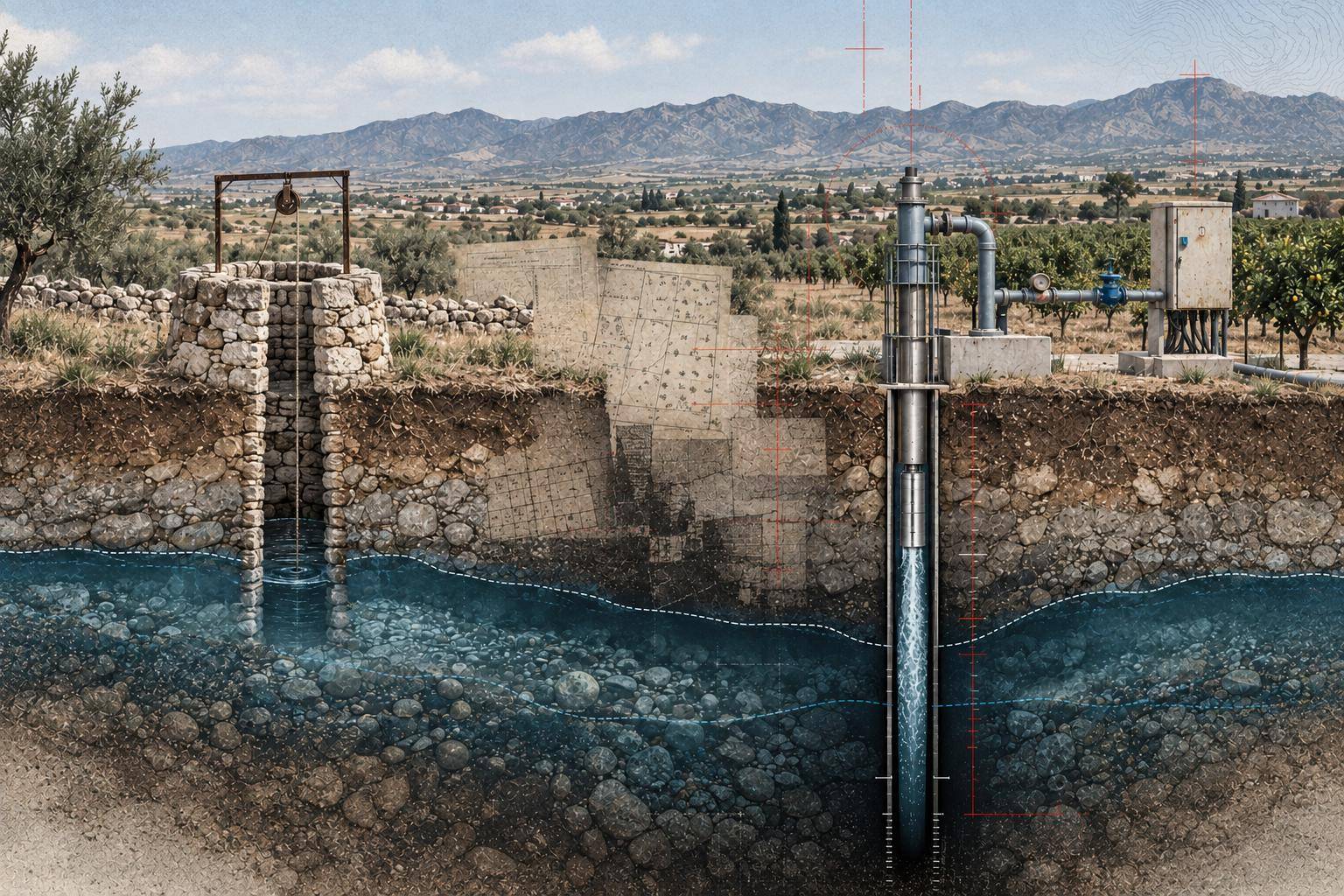
Cyprus has spent decades engineering its way around water scarcity. Dams, desalination plants and recycled wastewater have been added to a system in which groundwater remains indispensable, particularly for agriculture and communities outside the main water networks.
Seventy-six percent of irrigation supply came principally from private boreholes, a 2025 Audit Office review found.
But the underground reservoir on which Cyprus depends is already under pressure. Of Cyprus’ 22 groundwater bodies, 14 remained in poor condition, according to the audit report, down from 16 in the previous assessment in 2016. Nitrate pollution and seawater intrusion continue to affect several aquifers.
The state does monitor aquifers. The Water Development Department, or WDD, told auditors that quantitative groundwater monitoring includes 86 stations that take readings across the aquifers under the EU’s Water Framework Directive – which sets rules to prevent the deterioration of the bloc’s water bodies – and more than 800 additional local monitoring stations.
But there are gaps. In one aquifer, conductivity and temperature measurements had not been taken since 2018 because of staff shortages, according to the audit report.
The more fundamental problem is different: Cyprus monitors the condition of its aquifers, but it does not reliably know how much water is being removed from them.
That distinction goes to the heart of how groundwater is governed.
Cyprus does not lack rules for groundwater abstraction. Permission to construct a borehole is distinct from permission to use it. Abstraction permits can regulate how much water may be pumped, for what purpose, where it may be used and how that use should be measured.
When deciding whether to grant an abstraction permit, the WDD is required to consider the qualitative and quantitative conditions of the relevant water body, government water policy, the public interest and what it considers the applicant’s reasonable needs.
Charalambos Theopemptou, an environmental consultant, who served in Parliament between 2016 and 2026 and led the The Movement of Ecologists – Citizens’ Cooperation or the Cyprus Greens Party, argues that Cyprus’ problem is primarily one of implementation rather than an absence of legislation.
“A legal framework without implementation offers no real protection,” he told CIReN, pointing to the laws, regulations and decrees already governing groundwater.
He said the process for issuing abstraction permits had improved, but questioned whether the WDD had sufficient personnel to carry out inspections, pursue illegal abstraction and control over-pumping.
The system the WDD is responsible for policing is vast – and divided between an older legacy of licenses and a newer generation of records entered into its database.
The WDD told the Audit Office that Cyprus had 137,548 licensed boreholes in 2024. Of these, 98,720 had been licensed before 2010, when borehole licensing was handled by the district authorities. Another 38,828 had been licensed from 2010 onward by the WDD and entered into its database.
The older records have not disappeared. Akis Kikas, a director at the Audit Office, who handled the relevant audits, told CIReN that the WDD holds physical files and topographical plans for pre-2010 boreholes.
But he said the failure to enter many of them into the database limits the WDD’s ability to exercise oversight and prevents officials from having immediate, reliable and comprehensive information about the boreholes in each area.
More recent records supplied by the WDD to CIReN provide an updated picture of the newer, database-recorded part of the system.
As of March 31, 2026, the schedules list 46,353 abstraction points with approved annual pumping limits – 7,525 more than the number of post-2010 licensed boreholes the WDD reported in 2024. At the time of publication, the WDD had not responded to CIReN’s request to clarify what the difference may reflect. It may indicate additional boreholes licensed and entered into the system between 2024 and March 2026.
Together, the approved limits for those 46,353 abstraction points amount to approximately 149.4 million cubic meters a year.
But 149.4 million cubic meters is not a measure of consumption.
It is a measure of permission – and only of the abstraction points contained in the 2026 schedules supplied to CIReN.
The Audit Office found that inadequate monitoring means the amount actually extracted from Cyprus’ groundwater bodies each year cannot be calculated accurately. Estimates of excessive abstraction had been produced for illegal boreholes in one aquifer, but equivalent information was not available for licensed boreholes or other aquifers.
Kikas identified three practical reasons for that uncertainty.
Not all pre-2010 boreholes are in the database, and it is unclear whether – and to what extent – some remain in use; the WDD does not know what proportion of licensed boreholes comply with requirements to install meters. And even where meters are installed, the department does not systematically record their readings.
The result is a striking imbalance in what the state knows.
For tens of thousands of newer abstraction points, the WDD can record with considerable precision how much water users are allowed to take. It cannot establish with comparable precision how much licensed users actually take nationwide.
And, the 2026 records show that permission to pump is far from evenly distributed.
Of the 46,353 abstraction points in the schedules supplied to CIReN, 30,613 – roughly 66 per cent- are authorized to pump no more than 500 cubic meters a year. Together, they account for approximately 6.64 million cubic meters, or just 4.4 percent of the authorized volume in the schedules.
At the opposite extreme, only 665 points – around 1.4 per cent – are authorized to pump 30,000 cubic meters or more. Together, they account for approximately 101.5 million cubic meters, or nearly 68 per cent of all authorized abstraction in the schedules.
Broadening the group to those authorized to pump at least 10,000 cubic meters, and it comprises 1,533 abstraction points – about 3.3 per cent of those listed. Together, they account for approximately 114.5 million cubic meters – more than three-quarters of the total authorized volume.
That concentration matters because the WDD has repeatedly cited the sheer number of boreholes it is responsible for, alongside staff shortages, as obstacles to comprehensive inspection and enforcement.
Theopemptou raised the same concern, questioning whether the WDD had sufficient staff to inspect so many boreholes, pursue illegal abstraction and police over-pumping.
At the time of publication, the WDD had not provided CIReN with figures showing how many of the 665 highest-volume abstraction points have functioning meters, how many were inspected during 2025 or for how many the department possesses verified annual abstraction figures.
Theopemptou argued that monitoring and inspections should prioritize high-risk areas, supported by sufficient staff and measuring equipment.
The Audit Office official independently endorsed a risk-based approach. With inspection resources limited, he said efforts should focus primarily on the largest authorized consumers as well as users repeatedly found breaching limits or with broken meters.
He also suggested examining the use of smart meters for high-volume users and repeat offenders, allowing the WDD to monitor abstraction remotely and systematically
When the WDD knew how much was being pumped
The stakes are illustrated by a case in which the WDD did have that information. In the village of Monagroulli in the Limassol district, two companies had been pumping substantially more groundwater from five licensed boreholes than their permits allowed since 2015. The pumping reduced the yield of neighbouring boreholes, including wells used for a nearby village’s water supply and put the area’s groundwater zone at risk.
A hydrological study prepared in 2017 by the company in question and at the WDD’s request concluded that pumping more than 100,000 cubic meters annually from three of the boreholes would endanger the groundwater zone. The WDD subsequently imposed a combined annual ceiling of 100,000 cubic meters on those three boreholes.
The ceiling was exceeded in every subsequent period recorded by auditors.
Across all five boreholes, annual excess abstraction reached as much as 107,293 cubic meters.
The WDD had meter readings from the boreholes. Inspectors found one meter broken in May 2020. After it was replaced, it recorded 461 cubic meters in two days, which the Audit Office warned it indicated high pumping rates,
Yet enforcement was inconsistent.
The WDD pursued legal action against one of the companies for only some of the periods in which it repeatedly exceeded its permitted abstraction. It did not request charges against the other company for its documented over-abstraction.
The first company was fined €400 in April 2021 and €2,000 in September 2023.
Auditors found that the second judgment took into account as a mitigating factor that the company had no previous conviction and had complied, even though it had already been convicted and excessive abstraction was continuing – facts that, according to the report, the WDD had apparently failed to bring to the court’s attention before the judgment was issued.
Kikas said an earlier audit had found that the company appeared, in some instances, to have pumped up to 26 times the maximum permitted quantity.
He said the WDD waited about two years before taking legal measures and later suspended them. The WDD declined to comment on the case.
Five years after the original audit, the follow-up still found over-abstraction, inadequate enforcement, boreholes operating without renewed permits and about EUR 90,000 in unbilled charges.
Kikas characterized the case as a failure by the WDD to impose effective measures capable of deterring repeated non-compliance.
The audit, he added, found no evidence establishing that this resulted from political intervention or pressure in favor of the company.
“If a law is not implemented, high penalties and fines are not deterrents,” according to Theopemptou.
The WDD has responded more broadly to the Audit Office by arguing that audits, by their nature, focus on weaknesses and do not always convey all of the factors that led to the weakness identified.
The department pointed to years of severe understaffing and said that 54 additional employees were added between 2023 and 2025, alongside changes intended to improve its procedures.
How much should users be allowed to pump?
The problem is not confined to whether users stay within their limits.
A 2019 Audit Office investigation raised another question: how the permitted quantity itself was justified.
The auditor cautioned against treating the cases in two villages in the Limassol district as representative. Both were investigated following complaints, he said, and it would not be safe to generalize from them.
He nevertheless described the WDD’s broader borehole-inspection program for recording meter readings and detecting breaches of abstraction limits as “very limited”.
In the village of Agios Theodoros Agrou in Limassol, auditors found no records supporting the WDD’s original decisions in 2011 and 2012 to issue the groundwater-work and abstraction permits, or its subsequent decisions to renew and amend them.
For none of the relevant WDD decisions could auditors establish that the department had taken into account the qualitative and quantitative condition of the water body, government water policy, the wider public interest or the applicant’s reasonable needs. Nor could they substantiate any WDD study assessing the directly affected area, possible harm to existing water rights or natural flows, the condition of the Troodos groundwater body – which encompasses the Agros area, aquifer-monitoring measurements or comparable abstraction permits nearby.
In February 2018, the permitted annual abstraction was increased from 15,000 to 40,000 cubic meters.
The WDD relied on a privately commissioned hydrological study submitted by the applicant, but auditors found no documentation showing how the department had evaluated it.
The WDD disputed the implication that no technical assessment had taken place. It said a special study had been conducted, meter and groundwater-level readings were taken every two months and decisions relied on available quantitative analyses and technical information.
The problem, the department said may instead have been that material documenting officials’ assessment was not gathered in one obvious and readily accessible place.
The price of groundwater
Cyprus has another mechanism intended to restrain groundwater use: money.
Environmental and resource charges introduced in 2017 are intended not simply to raise revenue but to account for environmental damage and the opportunity cost associated with depleting water resources faster than they can replenish.
Article 9 of the Water Framework Directive requires water-pricing policies to take account of the recovery of water-service costs, including environmental and resource costs.
Yet the Audit Office found that, almost nine years after the regulations were introduced, the WDD still had not billed abstraction from all private boreholes.
Auditors said incomplete implementation weakened the charge as a deterrent against excessive abstraction and it prevented the WDD from assessing whether pricing was actually encouraging efficient water use.
The WDD says private-borehole users began receiving environmental and resource charges in 2020, three years after the regulations took effect. Billing was introduced progressively, it said, with priority given to users according to the quantities abstracted and categories carrying higher charges.
The consequences of incomplete billing are not theoretical.
In another case examined by the Audit Office, the WDD had not billed a company for environmental and resource charges on groundwater abstracted from its boreholes. The Audit Office estimated the outstanding liability for 2017 to 2023 at approximately €90,000, before any possible excess-consumption charges were included.
Auditors also identified an apparent disparity between farmers supplied by government water projects and those pumping from their own boreholes.
Cyprus imposes an excess-consumption charge when a user exceeds an approved allocation from a water project. But there is no equivalent over-abstraction charge when a user exceeds the permitted quantity from a private borehole.
The Audit Office official said the difference removes an economic tool for controlling excessive abstraction and creates unequal treatment between consumers.
Permits without guaranteed periodic review
There is another weakness in the system: even an abstraction limit that was properly justified when issued has not been subject to a legally guaranteed periodic review.
The Audit Office official said the existing legal framework already gives the WDD substantial tools and that most weaknesses identified by the auditors concern implementation.
He nevertheless identified the absence of an over-abstraction charge for private boreholes and the fragmentation of responsibilities as areas where the framework could be improved.
In November 2024, the European Commission opened infringement proceedings against Cyprus because national legislation did not require periodic review of water permits as required by the Water Framework Directive.
Cyprus subsequently acknowledged that its legislation needed to be amended. When the change had still not been adopted, the Commission issued a reasoned opinion in December 2025.
The Commission said periodic review is required so authorities can determine whether controls, including permits, continue to achieve their objectives and update them where necessary.
Theopemptou described mandatory periodic review as “essential.” He warned that where over-abstraction leads to seawater intrusion, current rainfall conditions could make the damage permanent.
The WDD has told CIReN that proposed legislation would introduce reviews every 12 years, alongside an abstraction register and stronger monitoring and enforcement provisions.
The amendment is now before Parliament.
The government tabled the bill on April 6, 2026, describing it as an effort to strengthen and update the framework for integrated and sustainable water management. It remains pending.
The proposal is also intended to bring Cyprus into compliance with Article 11 of the Water Framework Directive and to provide for regular review of abstraction and impoundment controls.
The proposed bill could strengthen the system. But it does not change the central gap exposed by the existing records: Cyprus can say with considerable precision how much water tens of thousands of licensed users are permitted to pump, yet it still cannot reliably say how much they actually do.
Without comprehensive meter data, systematic readings and effective enforcement, the state is left managing one of its most stressed natural resources without a complete picture of how heavily it is being used.
This article was developed with the support of Journalismfund Europe.